I got to thinking the other day about things I might write about. I realized that I've had an Android phone for more than 2 years and have yet to talk about those things that make smart phones great. So I am going to spend a bit of time reviewing and recommending a handful of apps that I find to be worth writing about, the free ones at least.
Whenever a conversation comes up with a friend thinking of getting a smart phone I mention that the number 1 app that I use and that I know others use is Google Maps. If you ever use a map program on your computer you know that it's a great way to get to new places and get around while you are in new places. Having this on your phone is awesome. I can't count the number of times when my wife and I have used it to find places to eat while we were already out somewhere. We love to read reviews of places nearby that we can see but are sometimes skeptical of. There have been times where Maps has helped my wife get home from trips around Los Angeles. And there have been many days where the traffic report in Maps has helped us avoid hours in gridlock. It's a no brainer really and it comes with almost any Android device. If you bought an Android phone and it wasn't already there you might consider returning it for something else.
Recently I read a good review for an app called Vlingo. Basically it is a voice search feature similar to Siri. Now Android comes stock with a voice search capability and has long before Siri ever showed up on an Apple device. Vlingo tries to expand on what is already there. One excellent feature is the safe driving mode. When turned on it will read your incoming text messages to you. It's not bad when going on long trips. Vlingo does a few things that Google's voice search doesn't. For instance it will open apps. I think this is the main shortcoming of the previous versions of Google's version. However, in coming months a new version of Voice Search is being packaged with the newest version of Android that will probably make Vlingo irrelevant. I'm not certain this feature will be ported to older versions of Android. So my recommendation is to go ahead and give Vlingo a try.
Another free app I recently downloaded that I can't get enough of is called Silent Time. This app is something that runs in the background once you set it up to provide you with, wait for it, silent time. I got used to CyanogenMod recently. CM has a similar feature built right in where you can set certain times of the day or night to not take phone calls. Silent time is a bit more powerful. It gives you options similar to alarm clocks. You can set up a lot of timers if you have a lot of needs. In my case I set up 3. I have 2 timers set up to make my phone shut up all night long during the weekdays and longer on weekends. I have a few friends in Africa that occasionally forget to parse the time difference when they call me. It's not fun having your phone ring in the middle of the night on a work day. Also since I use my phone as my alarm clock I find that I almost never turn it off at night. The last setting I have for church. Since I take my phone to church and always set it to vibrate I thought it would be convenient if the phone did the button pushing for me. The neat thing here is that it lets you distinguish between full silent and vibrate modes.
Some of my friends like to tell me they could never read a book on a phone. I currently have 4 apps designed mainly for reading. I have Nook, Kindle, Play Books and LDS Scriptures. At first I was skeptical of reading on such a small screen. I have been pleasantly surprised at how comfortable reading on a phone can be. I am currently reading The Reality Dysfunction on my Nook reader. There are a lot of eBook readers available now. Almost all of them have apps that can be used on a phone or a tablet. Why settle for 1 reader when I can have 4. I should add that they are not all equal. I personally prefer the Nook reader experience. The pages turn and it is easy to read type. I know other people prefer the Kindle app for other reasons. I have used them all and usually just read on whichever one sales me the book for the best price. If the prices are the same I default to the Nook. The apps are free though the books are not.
One last one I want to recommend trying is HeyTell. This is an app that reproduces the push to talk functionality of older phones like Nextel used to have. I remember my uncle had everyone on his construction crew carry those things around back in the day. Heytell doesn't use phone minutes. It sends short voice messages over the internet between users. It doesn't use your contacts like a phone either. You set up friend lists. Right now only a few people I know use it so I only message a few people. But for those few people it has replaced texting. It's simple and easy and the voice quality is excellent. The audio does come out of the speaker portion of your phone so if you have a bad speaker phone it will sound as good as your speaker can handle.
I have a lot more. I will follow this up later with some games and some things I actually spent money on.
July 2, 2012

May 7, 2012
Generic
A couple of months ago my dad was in town for a quick visit. As it so happened this coincided with my supply of ibuprofen running out. So we made a quick trip to the pharmacy.
For years I've been buying my pain killers from Costco. They have at least 3 versions of ibuprofen that I am aware of. Kirkland Signature branded, Advil and Motrin IB. For a long time we were buying the house brand because it is less expensive and you get loads of it. In fact the last time we bought this hulk of a bottle we had to throw away a significant portion of it because it expired.
After that incident my wife and I decided that we should try the Advil branded version. Mostly because it was large while not being overly large. We were fairly confident at the very least that we wouldn't be paying for so much that it would end up in the trash.
The first thing that we noticed with the Advil brand is that it effected our headaches faster. It also lasted longer. It cost more for sure but we were able to finish our first bottle before it expired. So we had a positive experience all around despite the added cost.
It ran out about the time my dad was in town. In a rush we needed some more and so we went to the pharmacy. I reached out for the Advil and my dad stopped me. He pointed out that the pharmacy brand was less expensive and you got a heckuvalot more. At this point I was not yet totally convinced of the efficacy of Advil. I figured it could have been in my head. So I conceded. I bought this outrageously large bottle of generic ibuprofen.
Over the following weeks my wife was taking a lot of pain killers. Basically she hurt her tailbone pretty bad giving birth to our son. She was very sore for a long time. She first brought to my attention that she was taking more drugs. She said that she was concerned that she was getting used to ibuprofen because she found that she was taking more of it much more often. Essentially she was taking 4 pills every 2-3 hours instead of her previous 2 pills every 4-6. She was getting really concerned.
I occasionally get headaches. Mostly they are related to occasionally drinking caffeine. So I took some one night. It was right around bed time. I was starting to feel a pretty massive headache coming on. I took 4 pills and waited it out. Nothing happened. When I say nothing I mean that 2 hours later the headache was hitting me full power and I had to take 4 more pills when I went to bed. I woke up with a headache. It was around that time my wife told me to throw that stuff away and go get some Advil.
Ever since I've been thinking about why those and other generic drugs don't seem to work as well as name brand products. I think it has to do with reputation. Think of it like the Tylenol company. They are a company named after a single product. If the quality of that product became bad they would lose a lot of reputation and a lot of money along side it. Because of this I am willing to bet these manufacturers go to great lengths to ensure their product is of the highest quality standards.
Conversely generic manufacturers have no reputation to uphold. The label that will ultimately end up on the outside of the bottle doesn't have their name on it. It has the name of the store they are making the product for. So there really isn't any reason to go to any great length to ensure quality of product. Cutting corners increases revenue.
I don't want to throw a blanket over all drugs and say the generics are never as good. I would say that for the most part they are not as good though. I don't use a lot of drugs but those that I do I prefer the name brand.
This past weekend I had a cold. I found in our drug cabinet 2 Sudofed generics. They were both said to be 12 hour pills. Neither of them lasted more than 6 and their level of effectiveness was definitely in question. Late in the evening I asked the wife to get me some real Sudofed. She bought a pack of the 24 hours stuff. I took it 13 hours ago and am still feeling fine.
The lesson here is somewhat anecdotal I'll admit. However I'll be sticking to the name brand stuff for drugs.
For years I've been buying my pain killers from Costco. They have at least 3 versions of ibuprofen that I am aware of. Kirkland Signature branded, Advil and Motrin IB. For a long time we were buying the house brand because it is less expensive and you get loads of it. In fact the last time we bought this hulk of a bottle we had to throw away a significant portion of it because it expired.
After that incident my wife and I decided that we should try the Advil branded version. Mostly because it was large while not being overly large. We were fairly confident at the very least that we wouldn't be paying for so much that it would end up in the trash.
The first thing that we noticed with the Advil brand is that it effected our headaches faster. It also lasted longer. It cost more for sure but we were able to finish our first bottle before it expired. So we had a positive experience all around despite the added cost.
It ran out about the time my dad was in town. In a rush we needed some more and so we went to the pharmacy. I reached out for the Advil and my dad stopped me. He pointed out that the pharmacy brand was less expensive and you got a heckuvalot more. At this point I was not yet totally convinced of the efficacy of Advil. I figured it could have been in my head. So I conceded. I bought this outrageously large bottle of generic ibuprofen.
Over the following weeks my wife was taking a lot of pain killers. Basically she hurt her tailbone pretty bad giving birth to our son. She was very sore for a long time. She first brought to my attention that she was taking more drugs. She said that she was concerned that she was getting used to ibuprofen because she found that she was taking more of it much more often. Essentially she was taking 4 pills every 2-3 hours instead of her previous 2 pills every 4-6. She was getting really concerned.
I occasionally get headaches. Mostly they are related to occasionally drinking caffeine. So I took some one night. It was right around bed time. I was starting to feel a pretty massive headache coming on. I took 4 pills and waited it out. Nothing happened. When I say nothing I mean that 2 hours later the headache was hitting me full power and I had to take 4 more pills when I went to bed. I woke up with a headache. It was around that time my wife told me to throw that stuff away and go get some Advil.
Ever since I've been thinking about why those and other generic drugs don't seem to work as well as name brand products. I think it has to do with reputation. Think of it like the Tylenol company. They are a company named after a single product. If the quality of that product became bad they would lose a lot of reputation and a lot of money along side it. Because of this I am willing to bet these manufacturers go to great lengths to ensure their product is of the highest quality standards.
Conversely generic manufacturers have no reputation to uphold. The label that will ultimately end up on the outside of the bottle doesn't have their name on it. It has the name of the store they are making the product for. So there really isn't any reason to go to any great length to ensure quality of product. Cutting corners increases revenue.
I don't want to throw a blanket over all drugs and say the generics are never as good. I would say that for the most part they are not as good though. I don't use a lot of drugs but those that I do I prefer the name brand.
This past weekend I had a cold. I found in our drug cabinet 2 Sudofed generics. They were both said to be 12 hour pills. Neither of them lasted more than 6 and their level of effectiveness was definitely in question. Late in the evening I asked the wife to get me some real Sudofed. She bought a pack of the 24 hours stuff. I took it 13 hours ago and am still feeling fine.
The lesson here is somewhat anecdotal I'll admit. However I'll be sticking to the name brand stuff for drugs.
March 22, 2012
HDR Photography: High Dynamic Ruin
So, as you may know from my new blog, I am beginning photography as a hobby. As a beginner I do a lot of reading about my hobby and a lot of viewing other photographer's work. One major theme has become quite apparent to me lately, everyone thinks HDR photography is amazing. I'm going to explain why it is somewhat fascinating and yet terribly ruinous at the same time.
HDR stands for High Dynamic Range. The basic technique is that of taking 3 or more pictures in a row, from a tripod so as not to change any particulars, using different exposure settings. The idea is that you can then later smash them all together in Photoshop to create a picture where every single element is exposed perfectly. Here is an example. Open this picture in a new window and we'll discuss it a bit as we go along.
Before I discuss the particulars of this I just want to explain a few limitations of this technology. First nothing can be moving. This means that if you see a person in the photo then it is probably not using HDR. This goes for animals as well. Second the photographer cannot move either. If anything moves the final product will contain ghosts.
Now let's get back to that photograph. Take a good long look at it. Do you see now how nearly every object and space is filled with light? There are wisps of shadow here and there but for the most part these are wiped clean and clear for everyone to see. Even where the shadow lies the object underneath is still easily visible.
You have looked and seen everything this picture has to offer. If you need more examples just search the internet for HDR photos. They are everywhere these days. Sadly a lot of people who call themselves professional photographers are now using this technique everywhere. I think it is suppose to testify to their customers that they own the expensive equipment deemed necessary to take these kind of shots. You will probably see on your next camera purchase that there is a built in HDR function. It will soon be a major selling point for any camera.
Let me tell you why I hate it. Mainly it creates a false portrait. It creates something unreal. What you see in this photo is hyper realistic. It's cartoonish. The colors are false and the textures are false. It's an absurd representation of the actual cathedral.
This is about where people I talk to start to disagree with me. Let me explain in a different way. When is the last time you looked at a Rembrandt? I included a link so you will look at it before reading further. This is a masterfully painted scene. It's dynamic. It's moving. It's still yet in motion. Why is this painting so amazing? Really think about it and I'll get back to why I think it is in a moment.
I just want to interject for a second and say that photography isn't painting but does rely on the same principles. The main principle of both is lighting.
Now when a child paints a scene or colors one in crayon without knowing the first principle of art they do something interesting. A child will almost always paint or draw a picture with no shadows. Everything is seen. Every object is in full clarity. Even kids I grew up with that were very good at drawing things that were easily identifiable drew things that didn't have shadow.
So why is this an issue? It's because of how our minds perceive the world around us. Did you know that humans only see in 2 dimensions? I bet you thought it would be 3. Nope. We only see in 2. Our brains have these little tricks that are employed to interpret things in 3 dimensions. Some of those tricks include interpretation of perspective, focus and contrast. I know this is more links than normal for my articles.
Up until now I have been trying to lean this conversation towards contrast. Go back to the Rembrandt painting for a moment. Do you notice where the light is coming from? Do you see how the shadow over the right half of the boat increases the idea of peril?
Let's look at one more painting. This time one from J.M.W. Turner. In this painting you can see the light source very clearly. What I find incredible about this painting is that the light draws your gaze onto a single ship. That source of light frames the subject. It tells our eye what to look at. Keep looking at this for a moment.
I want to point out another interesting thing. There are ships in this painting in the background that are out of focus. You know they are ships because they are reasonably in focus to show their sails but there is no detail. This tells your mind, without you even knowing, that this is 3 dimensional. Check back on the cathedral. Everything is in focus. If you look at it again it will start to feel flat. It's missing at least 2 of the main elements that the brain uses to interpret dimensions. It still retains perspective thankfully. Without perspective this photograph would probably cause headaches.
Okay, so I hope by now you can understand why I hate HDR photography. My challenge to my couple of readers is to look at photos you really like and paintings you really like and see if they aren't full of contrast and focal planes. We may have to live with high tech children's photos but we don't have to like them.
Once again, if you want to look at my photos check out the link to my other blog on the right hand side. See if I have any idea how to follow my own criticism.
HDR stands for High Dynamic Range. The basic technique is that of taking 3 or more pictures in a row, from a tripod so as not to change any particulars, using different exposure settings. The idea is that you can then later smash them all together in Photoshop to create a picture where every single element is exposed perfectly. Here is an example. Open this picture in a new window and we'll discuss it a bit as we go along.

Before I discuss the particulars of this I just want to explain a few limitations of this technology. First nothing can be moving. This means that if you see a person in the photo then it is probably not using HDR. This goes for animals as well. Second the photographer cannot move either. If anything moves the final product will contain ghosts.
Now let's get back to that photograph. Take a good long look at it. Do you see now how nearly every object and space is filled with light? There are wisps of shadow here and there but for the most part these are wiped clean and clear for everyone to see. Even where the shadow lies the object underneath is still easily visible.
You have looked and seen everything this picture has to offer. If you need more examples just search the internet for HDR photos. They are everywhere these days. Sadly a lot of people who call themselves professional photographers are now using this technique everywhere. I think it is suppose to testify to their customers that they own the expensive equipment deemed necessary to take these kind of shots. You will probably see on your next camera purchase that there is a built in HDR function. It will soon be a major selling point for any camera.
Let me tell you why I hate it. Mainly it creates a false portrait. It creates something unreal. What you see in this photo is hyper realistic. It's cartoonish. The colors are false and the textures are false. It's an absurd representation of the actual cathedral.
This is about where people I talk to start to disagree with me. Let me explain in a different way. When is the last time you looked at a Rembrandt? I included a link so you will look at it before reading further. This is a masterfully painted scene. It's dynamic. It's moving. It's still yet in motion. Why is this painting so amazing? Really think about it and I'll get back to why I think it is in a moment.

I just want to interject for a second and say that photography isn't painting but does rely on the same principles. The main principle of both is lighting.
Now when a child paints a scene or colors one in crayon without knowing the first principle of art they do something interesting. A child will almost always paint or draw a picture with no shadows. Everything is seen. Every object is in full clarity. Even kids I grew up with that were very good at drawing things that were easily identifiable drew things that didn't have shadow.
So why is this an issue? It's because of how our minds perceive the world around us. Did you know that humans only see in 2 dimensions? I bet you thought it would be 3. Nope. We only see in 2. Our brains have these little tricks that are employed to interpret things in 3 dimensions. Some of those tricks include interpretation of perspective, focus and contrast. I know this is more links than normal for my articles.
Up until now I have been trying to lean this conversation towards contrast. Go back to the Rembrandt painting for a moment. Do you notice where the light is coming from? Do you see how the shadow over the right half of the boat increases the idea of peril?
Let's look at one more painting. This time one from J.M.W. Turner. In this painting you can see the light source very clearly. What I find incredible about this painting is that the light draws your gaze onto a single ship. That source of light frames the subject. It tells our eye what to look at. Keep looking at this for a moment.
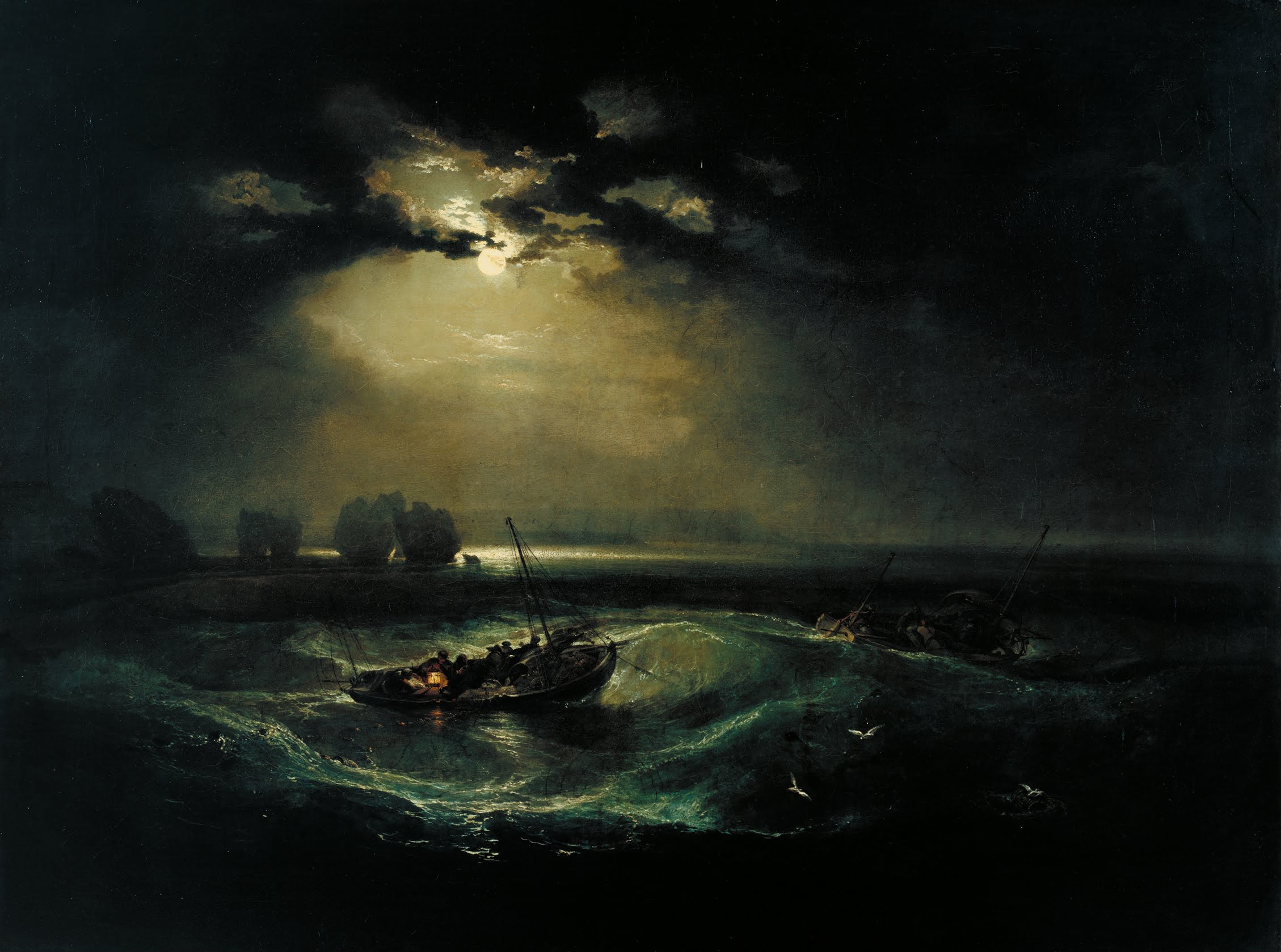
I want to point out another interesting thing. There are ships in this painting in the background that are out of focus. You know they are ships because they are reasonably in focus to show their sails but there is no detail. This tells your mind, without you even knowing, that this is 3 dimensional. Check back on the cathedral. Everything is in focus. If you look at it again it will start to feel flat. It's missing at least 2 of the main elements that the brain uses to interpret dimensions. It still retains perspective thankfully. Without perspective this photograph would probably cause headaches.
Okay, so I hope by now you can understand why I hate HDR photography. My challenge to my couple of readers is to look at photos you really like and paintings you really like and see if they aren't full of contrast and focal planes. We may have to live with high tech children's photos but we don't have to like them.
Once again, if you want to look at my photos check out the link to my other blog on the right hand side. See if I have any idea how to follow my own criticism.
Subscribe to:
Posts (Atom)